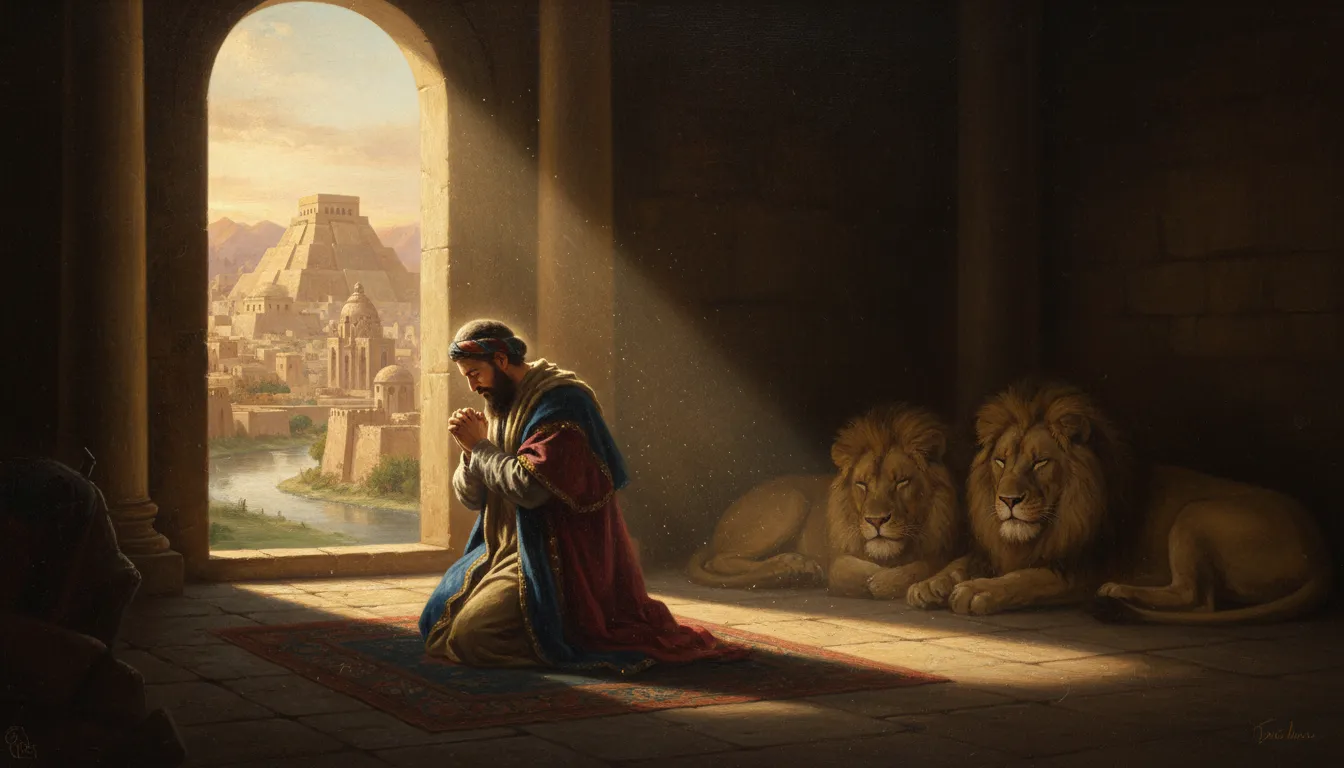
How Daniel Trusted God: Faith in the Lion’s Den
What do you do when the system is designed to destroy you?
When obeying God becomes illegal. When the authorities who hold your life in their hands issue a decree specifically crafted to eliminate you. When faithfulness to the One you serve means walking toward certain death.
That is the situation Daniel faced. And his response has been challenging and steadying the hearts of believers for over two thousand years.
The Daniel Bible story is more than an ancient tale about a man and some lions. It is a master class in what it looks like to trust God in hard times—not with passive resignation, but with active, costly, daily faithfulness. In a world that increasingly pressures believers to compartmentalize their faith, Daniel’s life offers a different vision entirely.
Who Was Daniel?
Daniel was a young Israelite nobleman taken captive to Babylon as a teenager, part of the first wave of deportees when King Nebuchadnezzar conquered Jerusalem around 605 BC. He was selected for royal service—educated in Babylonian literature, language, and culture, trained to serve the empire that had dismantled his world.
From the very beginning, Daniel made a quiet but firm decision: he would serve faithfully in Babylon without becoming Babylon. He would give the empire his labor and his loyalty in civil matters, but he would not surrender his identity as a worshiper of the God of Israel.
That distinction—serving without becoming—defined his entire life. Through the reigns of Nebuchadnezzar, Belshazzar, and into the era of the Medes and Persians, Daniel maintained his integrity across decades of political upheaval, personal danger, and cultural pressure. He rose to extraordinary influence not by compromising his convictions, but in spite of refusing to.
The Law Designed to Kill Him
By the time we reach Daniel chapter 6, Daniel is an old man—likely in his eighties—serving under King Darius the Mede. He has been appointed as one of three chief administrators over the entire kingdom, and his exceptional qualities have so distinguished him that the king is considering placing him in charge of the whole realm.
This is where the trouble begins.
His colleagues, envious of his influence and unable to find any fault in his work, devise a trap. They approach the king with a flattering proposal: issue a decree that for thirty days, no one may pray to any god or human being except Darius himself. Violation carries a sentence of death in the lion’s den.
The decree is written. The king signs it. Under Persian law, once the king signs such an edict, it cannot be revoked—not even by the king himself.
Daniel finds out.
What he does next is one of the most quietly radical acts in all of Scripture.
The Open Window
Daniel 6:10 records what happened:
“Now when Daniel learned that the decree had been published, he went home to his upstairs room where the windows opened toward Jerusalem. Three times a day he got down on his knees and prayed, giving thanks to his God, just as he had done before.”
Read that carefully. Daniel did not hold a secret prayer meeting. He did not adopt a temporary posture of spiritual self-preservation. He did not even dramatically announce his defiance.
He simply did what he had always done.
The open window facing Jerusalem was not a new act of protest. It was an old act of faithfulness, now made dangerous by political circumstance. Daniel’s faith was not performed for the moment of crisis—it had been practiced so consistently that crisis could not interrupt it.
This is the hidden lesson of Daniel in the lion’s den: the courage in the moment was made possible by the discipline of a lifetime.
When we speak of trusting God in hard times, we often focus on the dramatic moment. But Daniel’s story asks a different question: What are you doing on ordinary days? Because extraordinary circumstances reveal what ordinary faithfulness has built.
Before the Lions: Accountability to God Alone
Daniel’s enemies reported him immediately. The king, trapped by his own law and genuinely distressed about Daniel, worked until sunset trying to find a way to rescue him. But no loophole existed.
The moment before Daniel is thrown into the den carries words that echo across the centuries. King Darius, clearly moved, says to Daniel: “May your God, whom you serve continually, rescue you!” (Daniel 6:16)
Even a pagan king could see the thing that defined Daniel: he served God continually. Not conveniently. Not when it was culturally acceptable. Not when it carried no personal cost.
Continually.
There is a version of faith that functions as an identity label—something we claim on certain days and in certain company. And then there is the faith of Daniel, woven so thoroughly into the fabric of daily life that even those outside the covenant can name it.
The Three Friends: Faith That Does Not Require a Guarantee
Before Daniel’s lion’s den experience, three of his companions—Shadrach, Meshach, and Abednego—faced their own version of the same test. Threatened with the fiery furnace if they refused to worship Nebuchadnezzar’s golden statue, their answer stands as one of the boldest declarations of faith in all of Scripture:
“If we are thrown into the blazing furnace, the God we serve is able to deliver us from it, and he will deliver us from Your Majesty’s hand. But even if he does not, we want you to know, Your Majesty, that we will not serve your gods or worship the image of gold you have set up.” (Daniel 3:17-18)
But even if he does not.
Four of the most important words in the entire Bible. This is faith that does not bargain with God. Faith that trusts the character of God even when it cannot predict the outcomes of God. Faith that says: my obedience is not contingent on my survival.
That posture—trusting God in hard times without demanding a guaranteed result—is the beating heart of the entire book of Daniel.
The Morning After
Daniel is thrown in. The stone is sealed. The king spends the night fasting, unable to sleep, unable to eat, unable to be entertained. At the first light of dawn, he rushes to the den.
“Daniel, servant of the living God, has your God, whom you serve continually, been able to rescue you from the lions?”
And Daniel answers from inside the den:
“My God sent his angel, and he shut the mouths of the lions. They have not hurt me, because I was found innocent in his sight. Nor have I ever done any wrong before you, Your Majesty.” (Daniel 6:22)
The deliverance is complete. Daniel is lifted out without a scratch. The conspirators are thrown in and destroyed immediately. And Darius issues a new decree—that throughout his entire kingdom, people must fear and reverence the God of Daniel.
The man they tried to eliminate became the instrument through which the living God was proclaimed to an empire.
What Daniel’s Story Means for Faith During Trials
God Does Not Promise Comfort, He Promises Presence
Daniel was not spared from being thrown into the lion’s den. He was delivered from it. There is an important difference. The trial came. The threat was real. The night was long.
Biblical faith is not immunity from hardship—it is the assurance that God is present within it. When the three friends were in the furnace, Nebuchadnezzar looked in and saw not three men but four—and the fourth looked like “a son of the gods.” Presence in the fire, not absence from it.
Whatever trial you are facing today—whatever lion’s den has been sealed over you—the question is not whether the circumstances will be easy. The question is whether God is with you in them.
Integrity Under Pressure Begins with Integrity in Private
Daniel’s open window prayer was not a sudden act of heroism. It was the surface expression of a deeply formed interior life. Years of private faithfulness made public faithfulness possible.
The same principle applies to every area of discipleship. The choices we make when no one is watching shape the choices we are capable of making when everything is watching. Trusting God in hard times is not something we achieve in the crisis—it is something we cultivate long before the crisis arrives.
Your Faithfulness Has Consequences Beyond You
Darius’s declaration at the end of Daniel 6 is remarkable: the entire empire was pointed toward the living God because one man refused to close his window. Daniel could not have known, in that moment of decision, the ripple effects his obedience would create.
We rarely can. But faithfulness is rarely only about us. It testifies to others. It shapes communities. It bends the arc of history in ways we cannot track from where we stand.
Talking to Daniel Today
One of the most remarkable things about Daniel’s life is how modern it feels. The pressure to privatize faith. The institutional hostility toward public religious expression. The temptation to compartmentalize—to be one person at work and another person at home. The seductive logic of pragmatic compromise: just this once, just for a season, just until things settle down.
Daniel faced all of it. And he offers wisdom not as a distant historical figure but as someone who walked the same roads believers walk today.
Through ChristianAI, you can enter into conversation with Daniel directly—asking him about the pressures he faced, the disciplines that sustained him, and what he would say to someone trying to maintain faith in a culture that increasingly demands silence. His story is not finished speaking.
Applying Daniel’s Faith to Your Life
Establish Your Daily Practices Now
Daniel did not create his prayer habit under pressure. He maintained it under pressure. Before your next crisis arrives, ask: What are my non-negotiable daily practices of faith? What does it look like to pray and give thanks to God three times a day in your own life?
The open window is yours to open. The discipline of returning to it, day after day, is what makes you ready.
Know What You Will Not Compromise
Shadrach, Meshach, and Abednego had apparently thought through their limits before the furnace was lit. They were not improvising. They had already decided.
There is wisdom in identifying—in advance, in times of clarity—what you will and will not do when pressure comes. What are the things you will not surrender regardless of cost? Write them down. Pray over them. Hold them.
Trust God’s Character Over Your Circumstances
The most repeated thread through Daniel’s story is this: God is the living God. Darius calls Him that. Daniel lives as though it is true. The lions’ den did not change who God is—it revealed it.
Faith during trials is not optimism about outcomes. It is confidence in the character of the One who holds all outcomes. When circumstances look impossible, the question to return to is not “will this work out?” but “who is the God I serve?”
He is the same God who shut the mouths of lions. He is present in every furnace. He has not changed.
A Prayer Inspired by Daniel
Lord God, You are the living God, who endures forever. You shut the mouths of lions and walked with your servants in the fire. You were with Daniel in the darkness before dawn, and you are with us in ours.
Give us the courage to keep our windows open when the decree comes. Form in us the daily disciplines that will make us steady in the hour of crisis. Help us to serve you continually, not just conveniently—to trust your character even when we cannot see your hand.
Where we have compartmentalized our faith out of fear, break open the walls. Where we have privatized what was meant to be lived publicly, give us courage. Where we have grown weary of trusting you, refresh us with the testimony of your faithfulness.
We serve the God who delivers. And even if he does not deliver us in the way we hope, we will not bow down to what is not you.
Amen.
Want to go deeper into Daniel’s story? Start a conversation with Daniel on ChristianAI and ask him about the disciplines that sustained his faith, the loneliness of standing apart, and what it looks like to trust God across a lifetime of impossible circumstances.
Related Posts