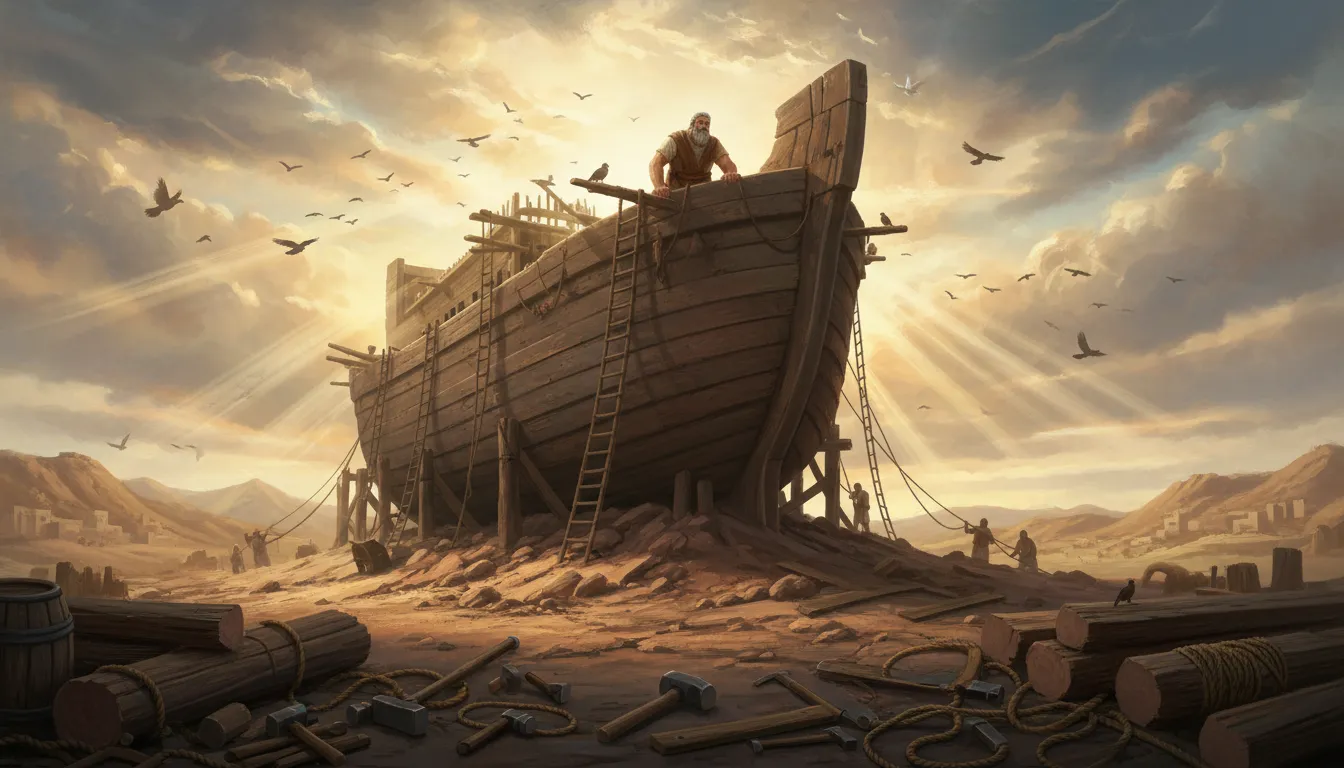
How Noah Obeyed God: Faith When the World Thought You Were Crazy
Picture building a massive ship in your front yard. No ocean in sight. No storm clouds on the horizon. Your neighbors think you have lost your mind. Your extended family whispers behind your back. Years pass. You keep building.
That was Noah’s life. And his story is one of the most extraordinary portraits of obedience in the entire Bible.
Noah’s story is not primarily about a flood or an ark or animals walking two by two. It is about what happens when one person chooses to trust God’s word over the visible evidence, over public opinion, over every rational argument against what God has asked.
The World Before the Flood
The Bible describes the state of humanity before the flood in devastating terms:
“The Lord saw how great the wickedness of the human race had become on the earth, and that every inclination of the thoughts of the human heart was only evil all the time.” (Genesis 6:5)
Every inclination. Only evil. All the time. The repetition is deliberate. This was not a society with a few problems. This was a civilization that had turned its back on its Creator so completely that the very fabric of human community had unraveled.
Violence filled the earth. Corruption was everywhere. The world God had spoken into existence with such care and delight had become unrecognizable.
And in the middle of all of it stood one man.
Noah Found Favor
“But Noah found favor in the eyes of the Lord.” (Genesis 6:8)
That single sentence changes everything. In a world drowning in wickedness before a single drop of rain had fallen, one man walked with God. The text tells us Noah was righteous, blameless among the people of his time, and that he walked faithfully with God.
This does not mean Noah was perfect. It means he oriented his life toward God when everyone around him had turned away. He maintained his relationship with God when there was no community of faith to support him, no church to attend, no worship music to play in the background. Just Noah and God, surrounded by a world that had forgotten both of them.
The Impossible Command
Then God spoke. And what He said must have been staggering:
Build an ark. Specific dimensions. Specific materials. Rooms inside, a roof above, a door in the side. Because a flood is coming that will destroy every living thing on the face of the earth.
Consider what this meant for Noah. There is no biblical record of rain before the flood. Noah likely had no frame of reference for what God was describing. He was asked to prepare for something he had never seen, based entirely on the word of someone he could not see.
This is the essence of faith.
“By faith Noah, when warned about things not yet seen, in holy fear built an ark to save his family.” (Hebrews 11:7)
The Long Obedience
Building the ark was not a weekend project. Scholars estimate it took decades. Every single day, Noah woke up and chose to keep building. Every day, he faced the same absence of evidence. No rain. No flood. No visible confirmation that God’s word was true.
And every day, the people around him had the same opportunity to mock, to question, to dismiss.
“Noah did everything just as God commanded him.” (Genesis 6:22)
That verse appears twice in the narrative, almost word for word. It is the Bible’s way of underlining something. Noah did not do most of what God asked. He did not do the parts that made sense and skip the parts that seemed excessive. He did everything. Just as God commanded.
This is what obedience looks like when it is rooted in trust rather than understanding.
What Noah Teaches Us Today
Noah’s story speaks directly to anyone who has ever felt alone in their faith. To anyone who has been asked by God to do something that does not make sense to the people around them. To anyone who is building something in obedience while the world watches and wonders.
Trust does not require understanding. Noah did not need to understand meteorology. He needed to know the character of the God who was speaking. When we know that God is faithful, we can obey even when the command seems impossible.
Obedience is daily. Noah did not build the ark in a single burst of spiritual enthusiasm. He built it one day at a time, one board at a time, through years of silent faithfulness. Most of the Christian life is not dramatic. It is showing up. Again and again and again.
God remembers the faithful. After the flood, the text says something beautiful: “But God remembered Noah.” (Genesis 8:1) God did not forget. He never does. Even when the waiting is long and the work is hard and the rain has not yet come, God remembers those who walk with Him.
The rainbow is a promise. After the waters receded, God set a rainbow in the sky as a sign of His covenant. It was not a reward for Noah’s obedience. It was a declaration of God’s character. He keeps His promises. He does not forget His people. And every time you see a rainbow, you are looking at evidence that the God of Noah is still the God of today.
Walking With God When No One Else Will
Noah’s greatest legacy is not the ark. It is not surviving the flood. It is the simple, repeated statement that he walked with God. In a world that had abandoned every trace of faithfulness, Noah kept walking.
That is available to you today. Not because you are perfect. Not because you have it all figured out. But because the same God who spoke to Noah in a corrupt and violent world is speaking still. He is still looking for people who will trust Him when it does not make sense. Who will obey when no one else is listening. Who will build what He has asked them to build, even when the sky is perfectly clear.
The rain came for Noah. And what God had promised was proven true.
He has not changed.
Want to explore Noah’s faith more deeply? Talk with Noah on ChristianAI and ask him what it was like to trust God when the whole world thought he was wrong.